
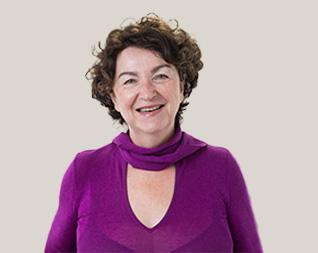
Ludmila was born in Moscow, in the former USSR, into a multilingual and cosmopolitan family, and received an equally multilingual education. After migrating to Australia in 1979, she completed a Bachelor of Arts in French and Russian with First Class Honours at the University of New South Wales (1983), and later earned a PhD (2000). In the mid-1980s, she became a NAATI-certified Russian-English interpreter and translator, working as a community, legal and conference interpreter and translator, as well as an SBS subtitler, before embarking on an academic career.
Experience at the Australian War Crimes Prosecutions (1989–93) and International courts and tribunals
A defining period of her interpreting career was her work with the Attorney-General’s Special Investigations Unit from 1989 to 1993. The Unit investigated suspected Nazi war criminals who had migrated to Australia after World War II. Her role took her throughout the former USSR as part of the Australian legal team where she interpreted both at high-level diplomatic negotiations in Moscow and Kyiv and working meetings and informal daily interactions in regional and remote areas of Ukraine. She was also tasked by the Director of Public Prosecutions (DPP) to identify the causes behind miscommunication and misunderstanding between Ukrainian witnesses and the South Australian Supreme court in the cases of defendants Ivan Polyukhovich and Heinrich Wagner. This experience also marked the start of her career as a researcher into court interpreting.
Ludmila’s research interests took her to some of the world’s most significant international criminal courts and tribunals throughout the late 1990s to mid-2000s, including the International Criminal Tribunal for the former Yugoslavia, the International Criminal Court and the Special Tribunal for Lebanon. Over more than 25 years of research in international and domestic courts, she concluded that the strength of effective interpreted communication in international courts resided primarily in the model inspired by the 1945-49 Nuremberg trials by the International Criminal Tribunal. She found that interpreters in contemporary international courts and tribunals have been an organic part of the courts’ design and operations. This has led to highly skilled and trained interpreters having their professional needs met, including teamwork in excellent facilities, the provision of briefing and preparation materials, and court judges and lawyers who understand how to communicate through interpreters.
Her research culminated in her Australian Research Council Linkage Project, Judicial Officers Working with Interpreters: Implications for Access to Justice, supported by eight partner organisations, including NAATI, Multicultural NSW and All Graduates. Her research also informed training programs for interpreters, judges and lawyers in both international and Australian jurisdictions on how to work with interpreters in bilingual proceedings.
Starting the interpreting and translation program at UNSW
Her career as an educator and academic started at UNSW in 1989 as a Russian language instructor. It was during this exciting perestroika period, leading to the collapse of the USSR and post-Soviet era which allowed her to conduct research in the newly opened Moscow-based Soviet archives. Her work in these archives led to a PhD, French intellectuals and Soviet Cultural organisations in the 1920s-1930s (2000), and monograph, Western intellectuals and the Soviet Union, 1920-40. From Red Square to the Left Bank (Routledge, 2007). Over time, she was promoted to Senior Lecturer, Associate Professor and Professor.
As both an interpreter and academic, she recognised the need for professional education pathways in translation and interpreting. With the support of UNSW Faculty of Arts and Social Sciences, she established the Master of Interpreting and Translation (MAITS), the university’s first postgraduate program in the field. The program immediately attracted both domestic and international students, including government-sponsored cohorts from Laos. For creating this NAATI-endorsed qualification, she received both the Dean’s and Vice-Chancellor’s Awards for Teaching Excellence in 2010. The program recently celebrated its 20th anniversary, and today continues to prepare interpreters and translators across 13 language streams using state-of-the-art technology.
Time as a Director on NAATI Board (2010–16) and TRAC Chair (2017–20)
Her longstanding association with NAATI began in the early 1990s as a Russian examiner and later examiner panel co-chair (with the late Rosh Ireland). As the only translation and interpreting expert on the NAATI Board from 2010 to 2016, Ludmila is proud to say that she was among those who contributed to NAATI’s major changes. Shortly after she joined the Board, NAATI embarked on the first overhaul of its credentialing system since its foundation in 1987. This overhaul (2012–18) included a total review of the system, resulting in the revision of the certification levels to address the industry needs and introducing new specialised credentials (legal, medical, conference interpreting); a new system of robust, reliable and verifiable certification testing, mandatory pre-testing training and mandatory recertification. During her Board membership, NAATI improved its financial sustainability and deepened engagement with its owners, the profession and the wider community. She is proud to have been part of the team that helped position NAATI to meet the changing needs of the industry and multicultural Australia.
Following her retirement from UNSW in 2026, she continues her work as an Emeritus Professor. While much has been achieved, she still has much to contribute with unfinished research and many exciting plans ahead.