
On this page
NAATI Certification for Aboriginal and Torres Strait Islander Language Interpreters


NAATI is the national standards and certifying authority for interpreters and translators in Australia.
NAATI sets and maintains high national standards for the translating and interpreting sector, and it is the only organisation to issue credentials or certification to interpreters and translators in Australia. NAATI is a public, not-for-profit company that is jointly owned by the Commonwealth, state and territory governments.
What is a NAATI-certified interpreter?
NAATI certifies interpreters who have met the national standard expected of interpreters. Being certified means an interpreter has completed interpreter training and prerequisites, and passed a test with NAATI. This test independently assesses their ability to interpret meaning accurately in both directions whilst maintaining the flow of conversation.
NAATI-certified interpreters have been trained to follow the AUSIT code of ethics including:
- confidentiality
- impartiality
- accuracy
- competence
- professional boundaries
- ongoing professional development; and
- professional solidarity.
All NAATI-certified interpreters recertify every three years if they wish to keep their credential. This demonstrates that they are actively maintaining their skills and knowledge.
Why is certification important?
NAATI-certified interpreters are professionals with a specific skillset. Yet untrained bilingual people are still often engaged in place of interpreters which can lead to serious consequences. This is particularly risky in high-stakes settings like health and legal services. Poor interpreting can result in significant economic and social costs, estimated to be as high as $1 billion* annually in Australia.
NAATI certification is a quality assurance mechanism. Quality assurance in interpreting is essential to ensure accurate, reliable communication. Engaging a NAATI-certified interpreter benefits everyone – the client, the organisation and the community.
*Economic analysis of interpreting services 2023, Deloitte, Language Services Sustainability Forum (Home Affairs)
Aboriginal and Torres Strait Islander language interpreting
Aboriginal and Torres Strait Islander language interpreters and translators ensure language speakers can fully participate in Australian society and keep their languages alive. These services exist thanks to the tireless work of Aboriginal and Torres Strait Islander interpreters, translators, advocates, and language organisations. NAATI has participated in this work by certifying Aboriginal and Torres Strait Islander language interpreters and translators since 1981.
Indigenous Interpreting Project
The Indigenous Interpreting Project (IIP) was launched in 2012 with state and Commonwealth government partners. The project aims to:
- Support Aboriginal and Torres Strait Islander language interpreters to prepare for NAATI certification.
- Certify Aboriginal and Torres Strait Islander language interpreters.
- Create more training opportunities for Aboriginal and Torres Strait Islander language interpreters.
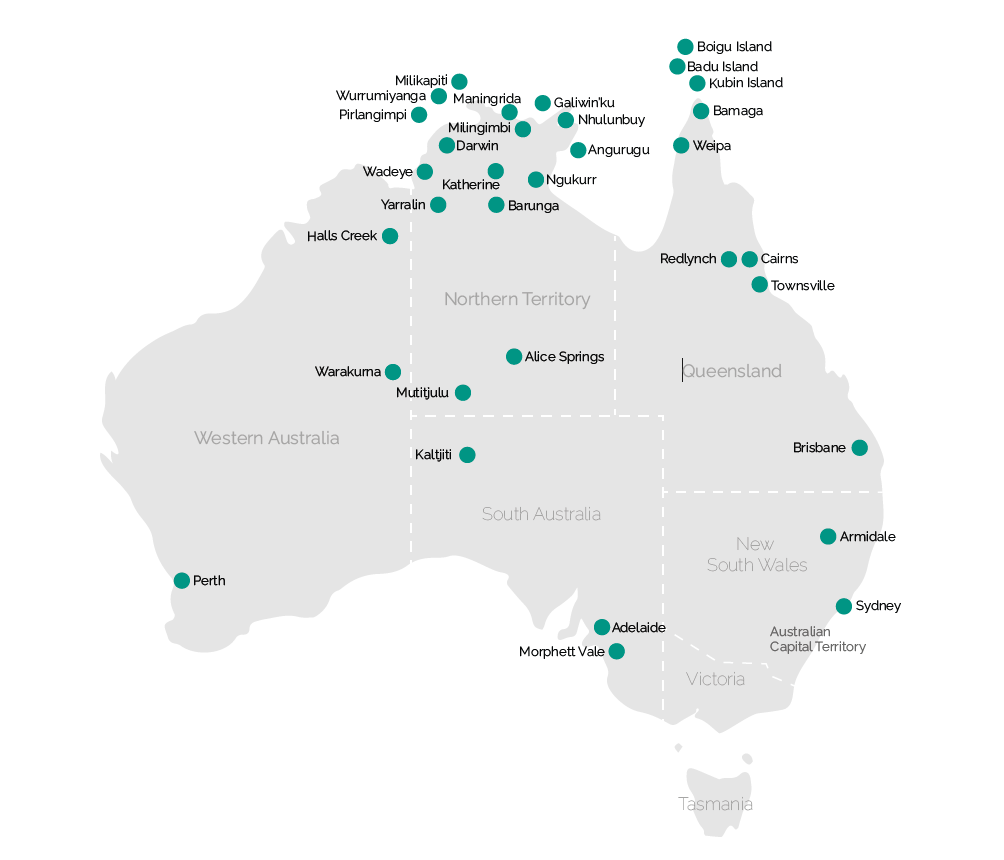
Locations of people who attended NAATI training under the Indigenous Interpreting Project 2025
Getting certified
NAATI Certified Provisional Interpreter (CPI)
Submit an EOI with details about English proficiency, language proficiency, interpreter training and interpreting work experience. NAATI will then let you know your next steps on the pathway to certification.
Pass the online prerequisites:
- NAATI Ethical Competency (EC) test
- Intercultural Competency (IC) test
- CPI preparation
To help you get ready for the EC and IC tests, you can do training with NAATI or elsewhere.
Face-to-face (F2F) workshops include final training, a practice test with role-players, and the actual test. Interpreters will get information about the three test tasks the day before their test.
The CPI test assesses your ability to provide quality, professional interpreting of non-specialised dialogues commonly encountered in daily life situations, using the consecutive interpreting mode.
The test consists of three live dialogue role-play tasks from different domains, to be interpreted in the consecutive mode. Two tasks are conducted face-to-face and one is via phone. Each task takes 10-12 minutes.
Recertify every three years.
Recertification requirements
To support the ongoing professionalism of the industry, any translator or interpreter wishing to maintain a NAATI credential must recertify with NAATI every three years.
More information about recertification can be found on our website: bit.ly/NAATI-recertification
Why is recertification important?
- Actively maintaining skills and knowledge.
- Support ongoing professionalism of the industry.
- Assures the community that only practising interpreters hold current NAATI credentials.