



Information for candidates
Below is a summary of the pathway to being awarded RPT.
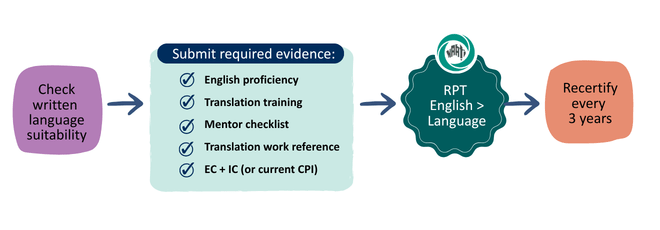
Read below about the requirements for written language suitability and individual applicant requirement. If you are interested in applying, please complete the Expression of Interest form, or contact iip@naati.com.au
Written language suitability check
For NAATI to award a translation credential (RPT) in a particular language, it is important to confirm that the language community has established accepted writing conventions. This should include rules for spelling (including alphabet, special characters), capitalisation, use of hyphens, guidance around spelling of loan English words, etc.
When NAATI receives an RPT application for the first time for a language, NAATI will request details of the key references for that language’s writing conventions, and seek to confirm that they are in use across multiple institutions (such as language centres and schools).
Applicant requirements
To be awarded an RPT credential, you must satisfy requirements relating to English proficiency, translation training and assessment, ethical and intercultural competency, and work practice, and provide evidence of these.
| Requirement | Details | Evidence |
|---|---|---|
| English proficiency |
Completed Year 12 or above (diploma, university); or English proficiency test (reading and writing CEFR B2) |
Certificate of completion or academic transcript |
| Translation Training and Assessment | Completed NAATI-approved translation training (Introduction to Community Translation) AND mentor checklist |
Certificate of completion Completed mentor checklist |
| Ethical and Intercultural Competency |
Passed NAATI EC and IC testing; or Exempt with current CPI credential |
NAATI will check internal records |
| Translation Work reference | Evidence of regular and recent written translation work with an LSP in the requested language | Completed translation work reference |
You must show evidence of strong English skills. This could be evidence of completing year 12, a tertiary or diploma course or complete an English proficiency test.
Further details available at Language Proficiency Requirements – NAATI
You must show evidence of formal translation training and assessment.
NAATI has evaluated the online course ‘Introduction to Community Translation’ offered via NexPD and determined that it meets the RPT training content requirement. However, the course does not assess skills. After completing this training, you will also need to ask a mentor to confirm your skills by looking at examples of your translation work using a checklist (see Mentor Checklist).
If you have not completed translation assessments as part of formal translation training, you will need a translation mentor to complete and sign a checklist. The translator mentor should be widely respected by the language community. The mentor must be a first language speaker who is also competent in the use of the accepted writing system. If there isn’t an individual mentor who is both a respected first language speaker and confident in the language’s writing conventions, the checklist should be completed by an established translation team who cover these skills.
The checklist asks the mentor to confirm that they have seen recent examples of your translation work and can confirm your skills. They will be asked to confirm that your work:
- translates the message accurately
- uses language that is grammatically correct and sounds ‘natural’ (idiomatic)
- uses the accepted writing system (spelling, hyphens, capital letters, punctuation, etc.), and
- uses appropriate style, word choices and English borrowings, for the genre and target (Language-speaking) audience.
Mentors will be encouraged to contact NAATI for assistance in explaining the expectations and process for completing the checklist. A NAATI staff member may contact the mentor to verify checklists that are submitted without assistance from NAATI.
You need to submit evidence that you have done written translation work from English into the requested language that is recent and regular. Ask your employer (Language Service Provider or LSP) to complete the ‘Work evidence reference’ template. NAATI requires evidence that you have completed translation work in the last 12 months (‘recently’), and shows you have done multiple assignments or completed translation work over several months (‘regular‘).
It also asks your employer to confirm that your work meets internal quality assurance checks and that they have no systematic concerns with the quality of your work.
Fees and access
NAATI will support the initial rollout phase of this credential by sponsoring the RPT application fee.
There is an enrolment fee for the ‘Introduction to Community Translation’ online course available through NexPD. This is currently being offered at a discounted rate of $199 for Aboriginal and Torres Strait Islander language translators (contact NAATI for a discount code).
Reimbursement: For applicants who successfully complete the online course and submit an application for RPT in an Aboriginal or Torres Strait Islander language, NAATI will reimburse this amount.
Submit an EOI
If you are interested in applying for RPT in an Aboriginal or Torres Strait Islander language, please complete the Expression of Interest (EOI) form. A NAATI IIP staff member will then work with you to check your eligibility, guide you in your next steps in compiling evidence, and assist in lodging your application for RPT.
If an application is complete and meets all requirements, the RPT credential will be granted.
Recertification
Like other NAATI credentials, the RPT credential is valid for 3 years. Practitioners can recertify their credential by providing evidence of professional development and language maintenance. Learn more about recertification here.